


Refrigerant dehumidifier
Refrigerant dehumidifier is one of the most popular and cost-effective solutions for drying compressed air. Their operation is based on cooling the compressed air to a low temperature, which causes the water vapour it contains to condense. The condensed condensate is then automatically discharged from the system.
Main advantages refrigeration dryers it:
- High dehumidification efficiency: Effective removal of large amounts of moisture.
- Low operating costs: Relatively low energy consumption compared to other dehumidification technologies.
- Simple design and operation: Easy to install and maintain.
- Compact size: They take up little space in the installation.
- Wide range of applications: Ideal for most standard industrial applications.
Refrigerant dehumidifiers are used in many industries, including:
- Engineering industry
- Lacquering
- Automotive workshops
- Food industry (depending on air purity requirements)
- Many other applications requiring dry compressed air
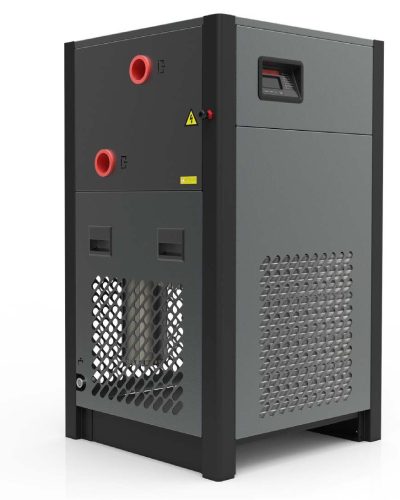
How does a refrigeration dehumidifier work?
Refrigerant dehumidifiery removes moisture from the compressed air by cooling it in a controlled manner. During this process, the temperature of the air is reduced to a level at which the water vapour it contains changes its state of aggregation and precipitates out as a liquid. This is most often done in the range of a few degrees above zero, which is fully sufficient for standard industrial installations.
The resulting condensate is continuously separated and removed from the system, while the dehumidified air is reheated before being directed to the rest of the system. This final step reduces the risk of moisture condensing back into the pneumatic lines and equipment.
The whole process is based on the collaboration of key elements, such as:
the heat exchange system responsible for cooling the air,
closed refrigeration circuit to stabilise the operating temperature,
condensate separator with automatic drainage.
Thanks to this design compressed air dryer provides a reliable and energy-efficient solution for compressed air drying that does not require complex methods or costly maintenance.

Zastosowanie osuszaczy ziębniczych
Refrigerant dehumidifiers stosuje się w:
- przemyśle produkcyjnym
- warsztatach i serwisach
- lakiernictwie
- branży spożywczej
- pneumatic installations
Są one standardem w większości instalacji sprężonego powietrza, gdzie wymagany jest punkt rosy ok. +3°C.
Kiedy wybrać osuszacz ziębniczy?
To rozwiązanie sprawdzi się, gdy:
- nie potrzebujesz bardzo niskiego punktu rosy
- zależy Ci na ekonomicznej pracy
- instalacja pracuje w standardowych warunkach
Osuszacz ziębniczy – oferta Marani
Marani oferuje osuszacze ziębnicze dopasowane do różnych wydajności i warunków pracy:
- dobór urządzeń pod instalację
- projektowanie systemów
- serwis i modernizacje
Contact, aby dobrać odpowiedni osuszacz ziębniczy.
FAQ – Osuszacz ziębniczy
Osuszacz ziębniczy standardowo osiąga punkt rosy na poziomie około +3°C, co jest wystarczające dla większości zastosowań przemysłowych i skutecznie eliminuje problem wilgoci w instalacji.
Osuszacz ziębniczy działa poprzez schładzanie sprężonego powietrza, co powoduje kondensację pary wodnej. Następnie kondensat jest usuwany, a suche powietrze trafia dalej do instalacji.
Osuszacz ziębniczy najlepiej sprawdza się w instalacjach, gdzie:
- nie jest wymagany bardzo niski punkt rosy
- liczy się ekonomiczna eksploatacja
- warunki pracy są standardowe
Osuszacz ziębniczy zapewnia punkt rosy około +3°C i jest bardziej ekonomiczny, natomiast osuszacz adsorpcyjny osiąga znacznie niższy punkt rosy (nawet -70°C), ale wiąże się z wyższymi kosztami eksploatacji.